How to Choose the Best Charging Phone Stand for Wholesale

Choosing the right Charging Phone Stand for wholesale is more than comparing prices. Buyers must evaluate charging performance, stability, compatibility, materials, packaging, and long-term reliability. A stand may look polished in product photos, yet wobble beside a laptop or overheat during repeated daily use. That gap matters.

Tony Fadell, a veteran hardware designer and former Apple executive, said, “Design is not just what it looks like and feels like. Design is how it works.” His principle fits this category closely. A dependable Charging Phone Stand should hold a phone securely, support practical viewing angles, and deliver consistent power without creating unnecessary clutter. For wholesale buyers, these details influence returns, customer reviews, and repeat orders.

Test the product in real conditions. Place a phone on the stand with a thick case attached. Check whether the charging area aligns correctly. Move the cable gently. Observe the base on glass, wood, and a crowded office desk. Small weaknesses become obvious.

Specifications still matter. Review supported devices, charging output, connector design, heat control, hinge strength, and surface protection. Ask suppliers for samples, inspection records, and clear warranty terms. Do not rely on attractive images alone.

There is no perfect model.

A low-cost stand may win initial approval but fail after months of folding. A premium design may impress customers but leave too little wholesale margin. This guide examines those trade-offs carefully, helping buyers choose a Charging Phone Stand that balances usability, dependable performance, and commercial value. Manufacturers also make mistakes, so verification remains essential.
How to Choose the Best Charging Phone Stand for Wholesale

What Is a Charging Phone Stand and How Does It Work?

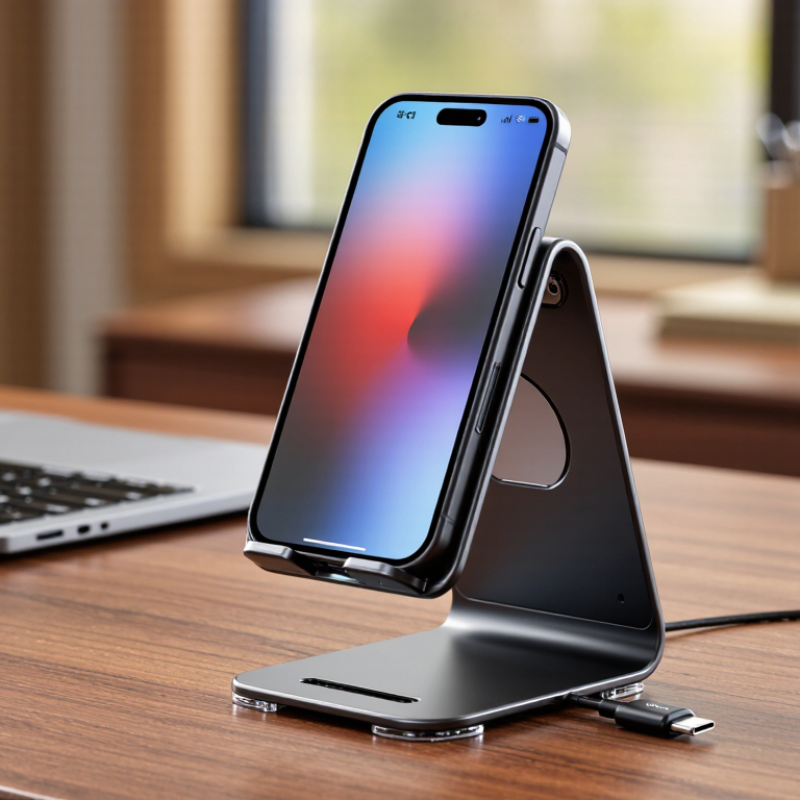
A charging phone stand is a holder that supports a phone while supplying power. It usually combines a stable base, an adjustable cradle, and a charging cable or charging coil. The phone rests upright, so users can view messages, video calls, or recipes while the battery fills.

The working process is simple. A wired model transfers electricity through a connector aligned with the phone’s charging port. A wireless model uses an induction coil in the stand and another coil inside the phone. When the coils meet closely, energy moves between them. Alignment matters. A thick phone case may slow charging or stop it completely. Heat can also build up during long charging sessions, especially on soft surfaces.

For wholesale purchasing, inspect the hinge, base weight, cable connection, and charging stability. I would place sample units on a crowded desk and adjust them repeatedly. Weak hinges often appear after this small test. Check whether the stand supports both vertical and horizontal viewing. Confirm output specifications with measured samples, not only printed packaging. A reliable supplier should provide clear technical data and consistent quality records. Still, no stand fits every user. Some buyers prefer fast charging, while others value a smaller footprint. This trade-off is easy to underestimate.
Which Charging Standards and Device Types Should You Support?

Wholesale charging stands should support USB-C Power Delivery for phones and tablets. USB-C is now the practical baseline for new inventory. IDC recorded approximately 1.24 billion smartphone shipments worldwide in 2024. That volume hides major differences in charging speed, port position, and case thickness. A stand designed for one phone shape will quickly create returns.

Wireless compatibility needs equal attention. Support the Qi standard for broad device coverage, then add Qi2 magnetic alignment where supported. The Wireless Power Consortium reports more than 13,000 Qi-certified products across the market. This includes phones, earbuds, and charging accessories. Buyers may also expect separate spaces for smartwatches and wireless earbud cases. They often place all three devices on one desk. Alignment matters. A phone that slips two centimeters may stop charging.

For wired output, choose USB-C PD with sensible power profiles, such as 20W, 30W, or higher for tablets. PPS support can improve charging efficiency on compatible devices. Keep one USB-A port only when your wholesale customers still serve older accessories. Omdia’s device market tracking shows continuing growth in connected personal devices, not only smartphones. Compatibility claims should remain specific. Do not advertise “universal” charging without testing cases, magnets, cables, and heat. That promise sounds useful, but it is easy to challenge. Test a mixed batch before committing to large volumes. Some cases remain awkward. That is where our own assumptions need revision.

How to Choose the Best Charging Phone Stand for Wholesale - Which Charging Standards and Device Types Should You Support?

A practical comparison of charging standards, supported device types, output levels, and wholesale selection factors.

Charging Standard or Method Typical Stand Output Recommended Device Types Alignment and User Experience Wholesale Advantages Important Limitations or Checks
Qi2 Magnetic Power Profile Up to 15 W for certified compatible devices Magnetic-compatible smartphones and protective cases Magnetic alignment improves placement accuracy and helps maintain the charging connection Strong user convenience; suitable for premium single-device stands and desk accessories Certification, magnetic strength, case compatibility, foreign-object detection, and thermal control should be verified
Qi2 or Qi Version 2 Extended Power Profile Up to 15 W, depending on the certified product and receiving device Qi2-compatible smartphones and other certified wireless-receiving devices Magnetic alignment may be included when the product uses the Magnetic Power Profile Provides a recognized wireless charging specification for broader international sourcing Do not assume every Qi Version 2 product has magnets; confirm the exact profile and certification status
Qi Basic Power Profile Up to 5 W Older wireless-charging smartphones, wireless earbuds, and small Qi receivers Standard flat or angled placement; magnetic alignment is not required Lower component cost and wide compatibility make it useful for entry-level and promotional products Slower charging; verify coil position, charging distance, case thickness, and foreign-object detection
USB-C Power Delivery Common stand implementations provide approximately 18–30 W; the USB-C PD specification supports higher power levels with suitable equipment Phones, tablets, handheld gaming devices, and other USB-C devices Wired charging; the device usually rests in a cradle while connected by a cable Efficient, familiar, and suitable for customers who prioritize charging speed over cable-free use Confirm supported voltage profiles, cable quality, power adapter inclusion, connector durability, and heat management
USB-C PD with PPS Often implemented in the 20–30 W range for phone stands; actual output depends on the power adapter and device USB-C smartphones and other devices that support Programmable Power Supply Wired charging with more flexible voltage adjustment than fixed-profile charging Can improve charging efficiency and reduce unnecessary voltage conversion for compatible devices PPS support is not universal; verify the exact PPS voltage and current range rather than relying only on the advertised wattage
Multi-Coil Wireless Charging Usually up to 5–15 W for the phone area, with total output limited by the design and power adapter A smartphone plus wireless earbuds or another small Qi-compatible accessory Separate charging zones reduce the need for multiple stands and cables Higher perceived value and better suitability for home, office, and travel bundles Check simultaneous output, heat dissipation, coil spacing, power-adapter capacity, and whether each zone operates independently
Dedicated Smartwatch Charging Module Typically low-power charging, commonly below 5 W; the exact level varies by device and module Smartwatches using a proprietary magnetic puck or dedicated charging interface Magnetic or contact alignment; usually requires a device-specific charging module Adds value to multi-device stands and supports a compact bedside or desktop setup Smartwatch charging is not universally standardized; compatibility must be tested with each target device family
USB-A Output Port Commonly 5–12 W on compact stands, depending on the port and power adapter Legacy phones, earbuds, fitness devices, and accessories using USB charging cables Wired charging through a user-supplied or included cable Useful for mixed-device households and markets where USB-A accessories remain common Generally offers less advanced power negotiation than USB-C PD; verify current limits and over-current protection
Best Core Combination
For broad wholesale appeal, consider a stand supporting Qi2 magnetic charging, standard Qi charging, and at least one USB-C PD output.
Device Coverage
Test bare devices and common protective cases. Charging performance can change with case thickness, magnets, metal parts, and camera-module dimensions.
Wholesale Quality Checks
Request certification evidence, temperature test results, foreign-object detection tests, power-adapter specifications, warranty terms, and sample testing before placing a large order.

Note: Advertised maximum output is not guaranteed for every device. Actual charging speed depends on the receiving device, charging protocol, adapter capacity, cable, alignment, temperature, and simultaneous use of other charging zones.

How to Evaluate Stand Design, Materials, and Charging Performance

Wholesale buyers should evaluate a charging phone stand as a daily-use tool, not merely a display accessory. IDC reported approximately 1.24 billion smartphone shipments in 2024, so compatibility must cover many device sizes and case thicknesses. Measure the cradle width, viewing angle, hinge resistance, and cable channel. A stable base should not slide when users tap the screen. Small details matter.

Material selection affects durability and perceived value. Aluminum supports a cooler, more rigid frame, while reinforced polymers reduce weight and shipping costs. Check surface texture, joint wear, and drop-test results from independent laboratories. The Wireless Power Consortium maintains certification requirements for wireless charging products, including alignment and safety controls. Certification evidence is stronger than a supplier’s broad performance claim. Still, plastic quality can vary widely.

Charging performance needs practical testing. Grand View Research estimated the wireless charging market at about USD 7.49 billion in 2023 and projected a 22.2% compound annual growth rate through 2030. That growth increases competition, but not every stand delivers its advertised output. Test charging with different phones, cases, and battery levels. Record temperature, charging time, standby consumption, and connection stability. USB-C Power Delivery support can improve wired reliability, but cable quality remains a weak point. I would not accept one successful test. Repeated tests expose heat buildup and loose connectors. A slightly slower, cooler stand may earn fewer returns.

What Wholesale Factors Affect Cost, Customization, and Minimum Order Size?

Choosing the best charging phone stand for wholesale requires more than comparing unit prices. Material, charging power, hinge design, and packaging all affect the final cost. A metal frame usually costs more than reinforced plastic, but it may feel steadier on a retail shelf. Higher charging output can also increase component and testing expenses. Ask for a clear cost breakdown.

Customization changes both price and minimum order size. A printed logo may require a small setup fee, while custom colors can require new material batches. Packaging changes are often overlooked. A simple branded sleeve may be affordable, but a molded insert can raise tooling costs quickly. Request a physical sample before approving a large run. Photos can hide loose hinges or poor cable alignment.

MOQ depends on factory capacity, component availability, and customization depth. Standard colors often allow smaller orders because they are already stocked. Custom colors may require hundreds or thousands of units. In my sourcing reviews, suppliers sometimes quote a low unit price but attach an impractical MOQ. That is not a useful saving. I once focused too heavily on the per-unit figure and underestimated storage costs. Review landed cost, sample fees, packaging, spare parts, and delivery together. A tiered quotation can reveal whether ordering 500, 1,000, or 3,000 units genuinely improves margin. Leave room for defects and market testing. Thin margins leave little room for mistakes.

How to Compare Suppliers, Test Samples, and Ensure Product Quality?

Choosing the best charging phone stand for wholesale requires more than comparing prices. Supplier evaluation should include factory experience, production capacity, communication speed, and quality records. Ask for clear product specifications, material details, charging output, warranty terms, and inspection procedures. A reliable supplier should provide relevant safety and electrical compliance documents for your target market. Vague answers deserve caution.

Always test physical samples before placing a large order. Check whether the phone remains stable at different angles. Test charging with several compatible devices and cables. Measure charging consistency, surface temperature, hinge strength, and wireless charging alignment. Run the stand for several hours, then inspect unusual heat, noise, or movement. Packaging also matters. Drop-test the packed sample gently and check for scratches or loose parts. One attractive sample does not prove stable mass production.

Tips: Compare at least three suppliers using the same checklist. Request samples from different production batches when possible. Record test results with photos and dates. Small details matter. Ask how defects are handled after delivery, not only before payment. I have found that fast replies can hide weak quality control, while slower suppliers may offer stronger documentation. This is not always true, so verify every claim. A pre-shipment inspection can reduce surprises, although it cannot replace your own sample testing.

How to Choose the Best Charging Phone Stand for Wholesale

Recommended supplier evaluation weighting for comparing samples, performance, and product quality

Product quality and charging performance receive the highest weight because they directly affect customer satisfaction and return rates. Before placing a wholesale order, test charging stability, phone compatibility, heat control, hinge strength, packaging, and safety documentation. Use the same checklist and scoring method for every supplier.