China remains a major sourcing base for phone accessories, including the growing Mobile Stand category. According to IDC, global smartphone shipments reached approximately 1.24 billion units in 2024, rising 6.4% year over year. More phones create more demand for desk holders, car mounts, foldable stands, and retail display supports. Grand View Research estimates that the global mobile phone accessories market was worth about $278.7 billion in 2023. Its forecast suggests continued growth through 2030. However, that figure covers many products, not Mobile Stand products alone. The comparison is useful, but not perfect.
Supplier selection requires more than attractive catalog photos. Buyers should examine load capacity, hinge durability, surface grip, packaging quality, and factory consistency. A stand that feels solid for one week may loosen after repeated folding. That detail matters. Ergonomics authority Dr. Alan Hedge offered a relevant principle: “The best posture is the next posture.” A well-designed Mobile Stand should support changing viewing angles, not force one fixed position.
This guide examines leading Chinese suppliers through product range, manufacturing experience, customization ability, certifications, quality controls, and export performance. It also considers practical details, such as screw alignment, silicone-pad replacement, carton protection, and sample response time. Some supplier claims remain difficult to verify publicly. That uncertainty deserves attention. A polished website is not proof of reliable production. Factory audits, third-party testing, and small trial orders provide stronger evidence. Readers should also remember that market reports use different definitions, currencies, and research methods. The numbers indicate direction, not absolute certainty.
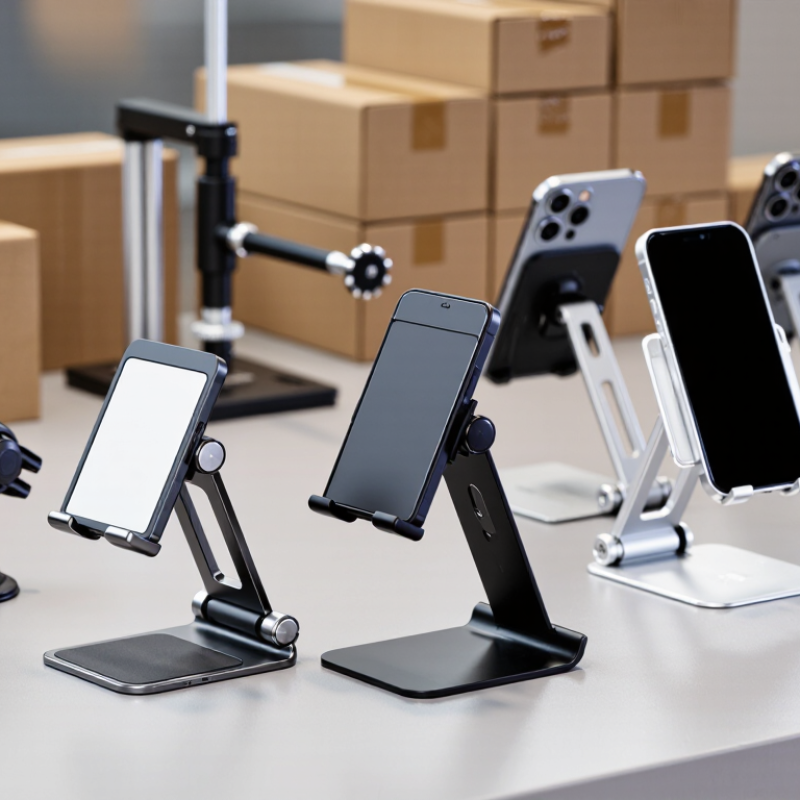
A reliable mobile stand supplier in China is defined by evidence, not attractive catalogs. IDC reported that global smartphone shipments reached about 1.24 billion units in 2024, increasing pressure on accessory makers to deliver consistent fit and finish. A capable supplier should provide material specifications, load-bearing results, surface-treatment details, and batch-level inspection records. Ask for samples from normal production, not specially prepared samples.
Factory control matters. ISO’s global survey places China among the largest markets for ISO 9001-certified organizations, but certification alone proves little about daily execution. Examine incoming-material checks, production-line inspections, final testing, and traceability. For folding stands, request hinge-cycle testing, anti-slip testing, and stability checks at different phone weights. An AQL inspection plan can help, although it cannot replace independent testing. Small scratches are easy to miss during a video call.
Communication is another practical test. Reliable teams confirm drawings, tolerances, packaging, and delivery terms in writing. They should explain what happens when a batch fails, including corrective action and replacement timing. Experience shows that the cheapest quotation can hide weaker alloys, thinner pads, or unstable packaging. I have also seen good suppliers lose reliability after rapid order growth. That risk deserves discussion. Review production capacity, subcontracting controls, and recent quality data before choosing a long-term partner.

Chinese mobile stand suppliers produce more than simple phone holders. Their catalogs usually include desktop, foldable, adjustable, magnetic, charging, and multi-device stands. Desktop models suit offices, classrooms, livestream desks, and retail counters. Foldable aluminum or reinforced plastic versions fit travel bags easily. Some designs use silicone pads to protect glass backs and painted surfaces. Others provide angle adjustment for video calls, reading, or product demonstrations. Small details matter.
For vehicles, suppliers offer dashboard, air-vent, windshield, and cup-holder mounts. These products often combine spring clamps, suction bases, or magnetic plates. Floor stands serve exhibitions, reception areas, hospitals, and public charging points. Wall-mounted holders save space in kitchens, workshops, and shared offices. Chinese factories also make tablet kiosks, lockable display stands, and custom counter units. Materials may include ABS, PC, aluminum alloy, stainless steel, or tempered glass. Some suppliers accept custom colors, packaging, and dimensions.
From practical sourcing experience, sample testing should happen before a large order. Check hinge strength, base stability, charging access, surface protection, and cable routing. Ask for load tests and material details, not only attractive photographs. A stand may look stable until a heavier tablet creates a small tilt. That weakness is easy to miss. I would also inspect carton protection and repeated-use performance. Suppliers with clear drawings, inspection records, and responsive communication appear more dependable. Still, no supplier is perfect; specifications can change between samples and production. Written approval and random inspection reduce that risk.
Chinese suppliers commonly offer a broad range of mobile stand products for retail, office, automotive, hospitality, and public-use applications. This comparison uses a normalized product-availability index, where 100 represents the most frequently offered category across general supplier catalogs. Desktop phone stands and vehicle mounts are among the most widely available types, while floor stands and kiosk-style solutions are usually produced for specific commercial projects.
China’s leading mobile stand suppliers should be compared by evidence, not catalog size. IDC reported 1.24 billion global smartphone shipments in 2024, creating steady demand for stands across retail and workplace markets. This scale makes production capacity important, but capacity alone proves little. Ask for monthly output, current utilization, and recent inspection records. Samples reveal more.
Check the stand’s alloy thickness, plastic grade, hinge strength, and anti-slip performance. A reliable supplier should provide material specifications, load tests, packaging details, and traceable quality procedures. The International Organization for Standardization reports that ISO 9001 supports consistent process control, but certification does not replace factory verification. Request a video audit or an independent inspection. Confirm whether the quoted price includes tooling, surface treatment, packaging, and replacement parts.
Compare minimum order quantities, sample fees, lead times, and defect policies in one spreadsheet. UNCTAD’s Review of Maritime Transport highlights continuing pressure on shipping costs and supply-chain reliability, so delivery promises need written conditions. Ask how suppliers handle damaged cartons, late components, and design changes. I have found that a polished sample can hide weak hinge testing. Numbers need context. My comparison may still miss seasonal labor shortages or subcontracting, especially when orders grow quickly. A small pilot order, followed by third-party inspection, gives stronger evidence than a persuasive sales presentation.
What Are the Top Mobile Stand Suppliers in China? What Quality Standards Should Buyers Evaluate?
Supplier selection should begin with measurable quality, not attractive product photos. The ISO Survey 2022 recorded 1,265,216 ISO 9001 certificates across 182 countries and economies. However, certification alone does not prove that every mobile stand is reliable. Buyers should request recent audit records, incoming-material controls, and corrective-action reports. Check aluminum thickness, plastic grade, rubber adhesion, and hinge alignment. A stand that wobbles on a glass desk has already failed its practical purpose.
Testing should match real user behavior. Require load testing at the advertised weight, repeated folding cycles, slip-resistance checks, and dimensional inspection. Ask whether samples came from normal production, not a carefully selected batch. ISO 2859-1 sampling plans can support consistent acceptance decisions. Surface coatings should resist sweat, scratches, and mild cleaning agents. For products with charging or electrical parts, request relevant safety and restricted-substance documentation. Industry compliance documents need traceable laboratory names, test dates, and model numbers. Vague certificates are warning signs.
The 2023 World Bank Logistics Performance Index ranked China 19th globally, supporting strong manufacturing and distribution capability. Still, logistics performance cannot replace product testing. My own evaluation would include a ten-day sample trial, because early impressions can mislead. Some suppliers may pass a static load test but fail after repeated hinge movement. Buyers should record every defect, even minor cosmetic ones. Small inconsistencies often reveal weak process control.
| Evaluation Dimension | Suggested Weight | Quality Standard or Benchmark | Evidence Buyers Should Request | Recommended Acceptance Criteria |
|---|---|---|---|---|
| Quality management system | 15% | ISO 9001:2015 certification with a scope covering design, manufacturing, or trading of relevant products. | Valid certificate, certification-body details, audit records, corrective-action reports, and quality manual. | Certificate is valid, independently verifiable, and matches the actual production location and product scope. |
| Material safety and compliance | 15% | RoHS Directive 2011/65/EU and amendment (EU) 2015/863 for powered or electronic models; REACH Regulation (EC) No. 1907/2006 where applicable. | Recent third-party test reports, material declarations, supplier declarations, and restricted-substance test results. | Reports identify the exact model, materials, test methods, laboratory, and test date; no unexplained material substitutions. |
| Load-bearing performance | 15% | The declared load capacity should be supported by a documented static-load test with a defined safety margin. | Test method, fixture design, load value, loading time, deformation measurement, and pass/fail records. | No fracture, tip-over, permanent functional loss, or unsafe deformation under the agreed test load. |
| Hinge, clamp, and adjustment durability | 12% | Repeated-use testing should reflect the stand’s adjustment mechanism, including hinges, telescopic sections, clamps, and locking parts. | Cycle-test procedure, cycle count, applied load, photographs, and post-test inspection results. | Buyer-defined cycle target completed without cracks, excessive looseness, loss of locking force, or unsafe collapse. |
| Dimensional and functional consistency | 10% | Critical dimensions should be controlled through approved drawings, tolerances, and calibrated measuring equipment. | Approved drawings, inspection plans, gauge-calibration records, and dimensional inspection reports. | All critical dimensions meet the approved specification; the product fits the stated mobile-device size range. |
| Surface finish and workmanship | 8% | Surfaces should be free from sharp edges, burrs, exposed corrosion, peeling coatings, cracks, and visible assembly defects. | Golden sample, approved appearance standard, incoming-material records, and final-inspection checklist. | No safety-related defect; visible defects remain within the agreed cosmetic sample and inspection limits. |
| Packaging and transport protection | 8% | Packaging should protect moving parts, finished surfaces, and structural components during normal international transport. | Packaging specification, carton-strength data, drop-test records where required, and packing photographs. | No product damage, corrosion, deformation, or missing components after the agreed transport simulation. |
| Incoming and final inspection controls | 7% | Inspection procedures should define sampling, defect classification, measurement tools, and release authority. ISO 2859-1 may be used as a sampling reference. | Inspection plan, sampling table, defect photographs, inspection reports, and batch-release records. | Critical defects are not accepted; major and minor defect limits are agreed before mass production. |
| Traceability and change control | 5% | Materials, production batches, tooling, and approved product changes should be traceable. | Batch codes, material certificates, production records, engineering-change notices, and retention policy. | The supplier can identify affected batches and obtain production records within an agreed response time. |
| Audit and corrective-action capability | 5% | The supplier should support pre-production audits, process reviews, root-cause analysis, and corrective-action verification. | Audit questionnaire, process-flow chart, CAPA records, internal-audit schedule, and response-time commitments. | Nonconformities receive documented root-cause analysis, corrective action, owner, deadline, and effectiveness verification. |
| Total supplier-evaluation score | 100% | Rank suppliers by weighted score, verified documentation, sample performance, and audit results rather than by price alone. | ||
Scoring guidance: Use a 0–5 score for each dimension, multiply the score by the suggested weight, and require corrective action for any safety-related or compliance failure.
Choosing the right mobile stand supplier in China requires more than comparing prices. A low quote may hide thin materials, weak hinges, or inconsistent finishing. Ask about aluminum grade, plastic type, load capacity, and surface treatment. Request recent product photos and a clear factory address.
In my sourcing experience, a physical sample reveals problems that product pages often miss. One sample can be revealing.
Test the stand with different phone sizes and cases. Check whether the base stays stable on glass, wood, and uneven desks. Ask the supplier for load testing records and quality inspection procedures. Do not accept vague answers. A dependable factory should explain its inspection points, packaging method, and replacement policy.
Independent inspections can verify dimensions, color, quantity, and carton strength before shipment.
Communication also matters. Send a simple specification sheet with drawings, measurements, logo placement, and packing requirements. Ask how the supplier handles design changes and delayed materials.
I once approved a sample too quickly, then discovered that its folding joint became loose after repeated use. That mistake taught me to request a durability test before placing a larger order.
Check minimum order quantities, production lead times, payment terms, and export experience. A capable supplier answers consistently and documents changes.
However, polished communication alone is not proof of reliable production. Visit the facility when possible, or arrange a documented remote audit.